What is Answer Engine Optimization (AEO)? The Ultimate 2026 Guide
Now it’s different when people look things up. Typing words into a box and tapping blue lines below? That’s fading out. Instead, voices talk to helpers who answer back like someone listening. Questions come in full sentences, almost casual. Machines reply with short versions of long answers pulled together fast. Up near the top of screens, smart systems show ready-made replies before anyone clicks anything.
Out of this change came something different – a fresh focus in online promotion called Answer Engine Optimization, or AEO.
Right now, your business might be invisible where most searches end – inside AI responses. Skip past old-school SEO alone, because attention has shifted beyond Google rankings. Picture this: queries answered instantly, without clicks. That is today’s reality. Instead of chasing links, think about shaping answers. Machines pull facts differently these days, using patterns people never see. Forget what worked last decade; relevance now means being chosen by algorithms as the source.
This isn’t speculation – it’s already happening across voice tools, chatbots, and smart assistants. To stay seen, brands must reframe content not for indexes but for interpretation. Authority no longer comes from backlinks only. It grows through clarity, structure, and consistency that machines trust. By 2026, guessing won’t cut it. You need precision. The shift? From optimization to recognition. From ranking to response.
Your message must survive translation into machine logic. Later sections reveal how top performers adjust tone, format, data placement, and context cues so systems pick their input every time. Think less like a marketer, more like an engineer feeding intelligence. Visibility hides in plain sight – if you know where to place each fact.
Answer Engine Optimization AEO?
Optimized content often shows up when AI tools respond to user questions. Instead of just ranking in search results, pages aim to be picked by systems like smart speakers or chatbots. These models pull answers straight from websites they trust. Getting featured means aligning with how machines understand information. Voice helpers and automated replies rely on clear, precise material. Digital content shaped this way tends to match natural queries. Machines favor responses that feel complete yet concise. Placement inside an AI reply happens when structure meets relevance. Trust builds through consistency across topics. Visibility shifts from clicks to being named outright.
Not like classic SEO, where getting clicks matters most, AEO aims at offering clear, organized responses – ready-made for AI systems to pull and show without needing a visit. Instead of chasing traffic, it prioritizes precision and trust so machines can deliver answers straight from the source.
Among those hit hardest by AEO are the main digital hubs it sets its sights on
Chatbot tools come from big tech firms. One by OpenAI talks like a person. Another made by Anthropic answers carefully. A third works through Google’s system. The last runs alongside Windows tasks.
AI Search Engines: Perplexity AI, Google AI Overviews, Bing Chat.
Apple Siri wakes your phone with a whisper. A question to Alexa spins answers from kitchen air. Google Assistant listens through screens big and small.
Featured Snippets: Position Zero on traditional Search Engine Results Pages (SERPs).
The Goal of AEO Is Zero Click Wins
Most folks judge old-school SEO on how many clicks show up. Yet with AEO, what counts is whether your name gets mentioned – citation strength plus how clearly you stand out. Picture someone asking an AI about your field; ideally, it pulls answers straight from your company’s details, knowledge, or offerings. What matters? Being the source behind the reply.
The Shift from SEO to Answer Engine Optimization
Start by noticing how search changed across two decades. See what shifted underneath. That sets the stage for why AEO matters more than any move lately. Watch how answers now come before links. Think about who gets seen when results skip steps. Spotting that change explains the weight of AEO today.
Traditional SEO The Link Era 2000–2015
Back before everything changed, Google mostly looked at keywords and who linked where. Ranking high meant landing somewhere in the first ten spots without much fuss. People scanned short previews then picked a link just to see if it helped.
Phase Two Semantic Search and Featured Snippets 2015 To 2022
Out of nowhere, Google rolled out RankBrain, then later BERT – both moving past simple keywords toward grasping what users actually meant. At around the same time, something called Featured Snippets appeared, oddly labeled Position Zero by some. These pulled exact replies from websites and stuck them right at the top of search listings. That setup? It quietly laid the groundwork for what came next in AEO.
Generative AI and Answer Engines Now
ChatGPT arrived. Then came Google’s SGE – suddenly, search wasn’t about pages anymore. Instead of listing sites, results began forming full replies on their own. Machines started reading, grasping meaning, crafting responses from scattered facts across the net. One thing became clear: old tactics won’t work here. Optimization now means shaping how algorithms interpret and rebuild knowledge – not just where you rank.
—
AEO vs. SEO vs. GEO: Understanding the Differences
Now here’s a twist – letters strung together in search marketing often blur into noise. Though they share common ground, think of SEO, AEO, then GEO (that’s Generative Engine Optimization) each chasing different shadows.
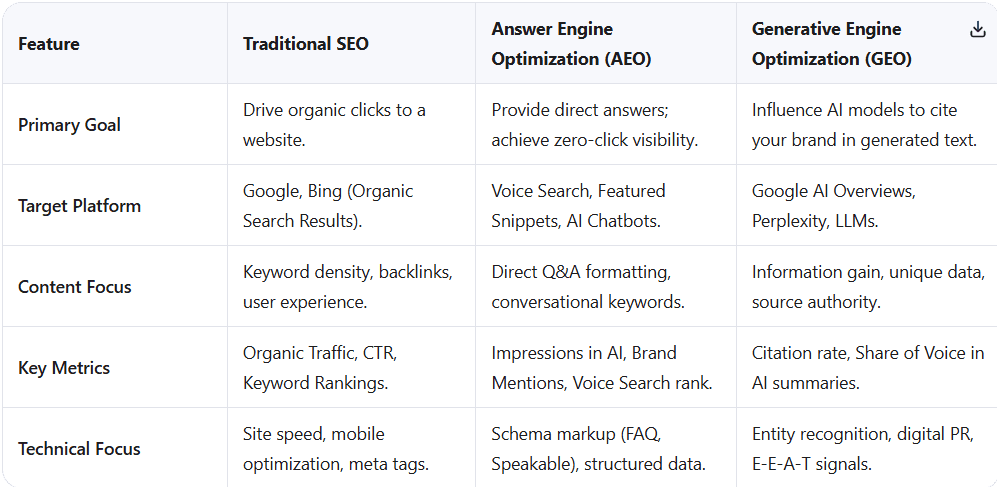
Here’s what matters. Picking just one of SEO, AEO, or GEO misses the point entirely. Think of them working together, each playing its own role. Start with SEO – it sets up credibility online. Then comes AEO, shaping how information gets pulled out clearly. On top of that, GEO steps in so artificial intelligence sees your name as reliable. Together, they form something stronger than any alone ever could.
How Answer Engines Handle Information
Start by seeing things from the machine’s point of view. Machines scan pages differently than people do, pulling facts in chunks. Retrieval-Augmented Generation is what powers tools such as Perplexity or Google’s AI summaries. This method grabs data first, then builds answers.
Step one begins when a robot scans pages across the web. It moves through links like water flowing downhill. A machine reads your words during its nightly travels. Information gets stored in hidden corners of digital libraries. When someone asks a question, the system digs into those collections. Your work appears if it matches what they seek. Citations happen automatically – no handshakes, no warnings. Credit shows up like footprints after rain
A computer reads what someone types. By using smart tools, it figures out the meaning behind words instead of just matching them. What matters most is spotting key details plus guessing what the person really wants. This step turns messy human questions into something clear enough for machines.
Out there, buried in a sea of pages, the system hunts down documents that match what you’re after. Think quality sources, ones that have been seen before and deemed trustworthy. Getting found here? That hinges on how well your site plays with crawlers. Old-school optimization still counts, more than some admit.
Chunks come first. Splitting pages helps spot key details. Headings guide the process. Structured bits stand out easily. Direct responses get flagged fast. Format plays a role here. Clear layout makes a difference.
Putting it together, the system builds a clear reply using top bits of info. After that, links get added so you can check where things came from. Here’s when GEO and E-E-A-T play their part. Quality shows up in how well everything connects.
Without clear headings, a solid block of text breaks the AI’s ability to chunk it properly – so nothing gets seen. When information piles up with no breaks, processing stops dead in its tracks. A messy layout means the system skips right over it, like unread mail piling on a desk. Structureless writing vanishes into silence because splitting it becomes too hard. Hidden behind density, even good ideas go unnoticed when there is no path through.
Seven ways AEO works in AI search by 2026
With the basics clear, what follows are precise steps – tailored to sharpen your site’s performance under Answer Engine Optimization. These methods connect directly to real results, shifting focus from theory to motion. Each move fits a larger pattern, yet stands strong on its own. Think of them as tools, not rules. They respond when applied, without needing extra force. The path unfolds through small changes, not grand gestures. Clarity comes before speed, every time. Adjustments stack quietly until they show.
1. Handle Questions Like Natural Talk
Most times, artificial intelligence learns by studying how people talk. Instead of typing stiff phrases, folks pose questions just like chatting with someone they know. Because of this, targeting brief search terms isn’t enough anymore – focusing on full-sentence questions works better now.
best crm software
AEO Keyword: “What is the best CRM software for small real estate businesses?”
Start by exploring platforms such as AnswerThePublic, AlsoAsked, or the “People Also Ask” drop-down in Google searches – this shows real queries people type. Right after spotting a common question, build an H2 or H3 header around it. Then, without delay, follow that heading with a clear reply in the next block of text. What matters is matching what users wonder with honest answers just below. Structure helps, yet clarity drives understanding forward. Place each response close to its prompt so nothing feels buried. Seeing a pattern in search behavior? Shape sections around those repeated phrases. Headings become signposts when paired with immediate explanations. Skip filler. Go straight from query to reply. That rhythm builds trust slowly, over time.
2. Inverted Pyramid Writing Style
Start strong, like news writers do with their upside-down triangle method – AI finds that useful too. Put the key point up front instead of hiding it. Answer questions by giving what matters most right away, within the first forty words if possible.
Example of Bad AEO Layout
> “There are many factors to consider when looking at website speed. Server location, image sizes, and code bloat all play a role. Ultimately, to fix your website speed, you should compress your images.”
Perfect AEO Format Example
> “To fix your website speed, you must compress your images, enable browser caching, and use a Content Delivery Network (CDN). Image compression alone can reduce page load times by up to 50%…”
Start with the answer right away. That way, it’s more likely the AI picks up your sentence for a Featured Snippet or AI Overview. Placing key info upfront helps it stand out clearly. When the response comes fast in the text, systems tend to grab it without delay. The earlier it shows, the better its odds of being chosen. Getting seen by AI often depends on position, not just quality.
3. Organize Information for Clear Machine Processing
Computers handle organized details better when they’re neatly arranged. Because of how systems learn, clear layouts help people see connections just as fast as algorithms do. What shows up on screen should flow like a path – each piece leading naturally to the next. Machines spot patterns quickly if the layout isn’t messy. When things are placed with care, understanding comes without extra effort.
essential formatting rules for aeo
Start strong with a single H1 at the top. After that, bring in H2s to mark major sections. When ideas branch deeper, shift to H3s for finer points. Moving down? Step through each level – no jumping ahead.
Start strong by breaking info into bullet points. That way, artificial intelligence grabs each piece without confusion. Think of it like steps – clear, separate, one after another. Numbers help when order matters. Items stand out more when they’re on their own line. This format? It plays well with machines scanning for facts. Each point gets seen, not buried in paragraphs. Structure shapes how answers get built later.
Start strong – comparison charts often help machines sort traits, strengths, weaknesses. A grid layout lets details stand side by side without clutter. Think of it as a quiet organizer for matching options. These structures give clarity when choices blur together. One glance might replace long paragraphs. Details line up neatly, making differences obvious fast.
Bolded terms highlight central ideas, crucial definitions, plus main points. These stand out so natural language processing systems can quickly spot essential elements within the content.
4. Use advanced schema markup with JSON LD
Hidden clues live inside your webpage code. These hints guide robots through what your words really mean. When answers matter most, certain patterns become essential tools. Each tag acts like a whisper pointing toward true meaning.
Schema for AEO
Questions and their replies stand out clearly when using FAQPage Schema. This setup guides artificial intelligence systems straight to the relevant sections. Each Q and A pair becomes easier to spot. Instead of guessing, machines recognize exactly where answers begin. Structure matters because clarity helps bots understand content faster. When markup defines question blocks, responses follow naturally. Recognition improves when patterns stay consistent across pages.
Audio-friendly parts of a story get marked by Speakable Schema. This helps machines pick up spoken bits easily. Voice tools rely on these signals to read aloud what matters most. Sections meant for ears, not just eyes, stand out clearly here.
Step-by-step directions? That format works well with HowTo Schema. Instructions become easier for artificial intelligence to pull out and speak clearly. The structure helps break things down naturally.
Start strong by showing who you are online through clear connections between your site, social pages, and real-world spots. A structured setup lets machines grasp your business identity without confusion. Picture this – search tools see your name, links, and address tied neatly together. Instead of scattered details, they find a unified profile that makes sense across platforms. Think of it like giving directions using landmarks everyone recognizes. Your digital presence gains clarity when pieces fit logically. Machines notice consistency, then trust builds slowly over time.
5. Build Topical Authority and Entity Salience
Most times, artificial intelligence picks references that show full understanding of a topic. One piece on a subject rarely gets noticed by these systems. Building strong recognition in a field matters more than isolated posts. Expertise spreads across many pages, not just one.
Building Topical Authority for AEO
A big main page kicks things off, diving into one wide subject. Smaller pages tie into it, each zooming in on separate pieces of the whole. One strong hub connects to around ten or more focused follow-ups. Each piece digs deeper, standing apart yet linked back. The structure grows outward like roots spreading under soil. Links flow both ways without needing permission. Every cluster page handles its own corner thoroughly. Topics split naturally instead of being forced together. Detail lives where it belongs, close to related ideas. Navigation happens through connection, not menus. Relationships between subjects show up clearly. Pages support each other by staying close online. This setup helps readers move smoothly from general to narrow. Depth builds slowly across multiple stops. Understanding grows step by step.
Pages should point to one another, deeply. When they do, meaning builds across them – clear signals form for AI bots scanning content. Authority grows quietly through these connections. Each link acts like a quiet nod between related ideas. Crawlers begin seeing the group as a single strong voice on the subject.
Start strong by making sure your company’s name shows up often alongside main topics people search for. What matters is that leaders and what you offer appear together online, tied to familiar terms in your field. Over time, systems begin linking those pieces naturally, treating your business like a known player. When details repeat in context, they stick inside smart networks as go-to references.
6. Leverage Digital PR for AI Trust Signals
What makes a website seem reliable to artificial intelligence? The system checks outside references instead of just reading the page itself. Links pointing to your site act like votes from other places online. Mentions across digital platforms also shape that impression. Trust builds when multiple independent sources highlight your content.
Pages from big-name outlets – Forbes, say, or TechCrunch – pointing at yours? That signals reliability. The machine notices. Trust in your site gets a quiet boost. Authority flows through links, silently lifting rankings.
Start by building a digital PR plan. Share fresh research or one-of-a-kind data reports instead of generic updates. Offer insights from your team’s expertise to stand out. Reach out to reporters and niche writers with stories worth sharing. When trusted websites mention your work, AI systems notice faster. Being featured where others look boosts visibility without extra effort.
7. Focus on Experience Expertise Authoritativeness Trustworthiness
What Google calls E-E-A-T – Experience, Expertise, Authoritativeness, Trustworthiness – shapes how AI handles sources. Content built on strong E-E-A-T gets top priority when machines learn what to trust. Instead of just collecting data, systems look for depth, proof of knowledge, real-world use, and honesty. Because of this standard, not every answer carries equal weight online.
What we saw while using it matters most. Our team tried everything firsthand. We ran tests across real projects. These examples come straight from our workdays. Every detail reflects actual use. In our agency, results shaped each point. We watched how things played out. What follows comes from that time together.
Start with someone who knows what they’re talking about – credentials matter when it comes to trust. Bios should show real background, not vague claims, tied directly to where that person has worked or written before. Link out to their actual LinkedIn so readers can verify expertise on their own terms.
Winning prizes helps people trust your business more. Teaming up with respected companies adds credibility too. Links from well-known websites boost how others see you.
Start with a secure connection using HTTPS so visitors feel safe browsing. Clear privacy rules help people understand how their data is handled. Show real contact details that prove you are who you say you are. Facts matter – only share info checked for accuracy, nothing guessed or assumed.
Tools You Need for Answer Engine Optimization
Without measurement, improvement is impossible. Though old-school SEO software works well, answering engine optimization needs another kind of setup. For 2026, these resources fit right into building and watching your AEO approach:
1. content structuring and optimization
Out of the sea rises a tool that digs deep into what ranks high online. It checks every bit of meaning your words carry alongside how natural they sound. One moment you’re looking at keywords others miss. Then comes clarity – what matters shows up plain. Thoughts get shaped by patterns found in real results. Not magic, just precision hiding in data streams.
A fresh approach begins with MarketMuse – AI shapes how topics connect. One path leads through organized clusters, another builds depth across subjects. It pieces together themes where ideas overlap. Structure emerges without force, guided by patterns machines detect. Words group not by guesswork, but signals beneath search behavior. Insight forms slowly, then all at once. Authority isn’t claimed. It grows.
2. Question and Intent Exploration
AnswerThePublic: Visualizes search questions and prepositions. Essential for finding conversational queries.
Hidden queries come into view when you peek at what people keep typing next. Questions unfold in layers, one after another like steps down a path most never notice. Each layer reveals something new about what minds really wonder. This tool lifts the curtain on those nested thoughts pulled straight from search results. What shows up is raw curiosity, organized without polish or script.
3. Tracking AI Citations and Visibility
What if you could see when bots talk about your name? Peec AI along with Brand24 does just that – spotting mentions across systems such as ChatGPT or Perplexity. These tools notice citations others miss, quietly logging every reference.
Nowadays, Semrush and Ahrefs still stick around – even though they’re old-school, their Position Tracking tools follow Featured Snippets along with AI Overviews. Though built years ago, these platforms quietly added new tracking modes. You’ll find snippet positions tucked inside reports instead of buried under menus. Their updates roll out without fanfare, yet cover emerging result types. Not flashy, just steady evolution hiding in plain sight.
4. Technical Schema Implementation
Start strong with RankMath or Yoast SEO – both shape JSON-LD schema neatly inside WordPress, zero coding needed. One fits if you like simplicity, another thrives on depth. Each builds structured data quietly while you focus elsewhere. Behind the scenes, they feed search engines clear signals. Pick either, really. Setup flows smooth once you begin. Little effort, yet results show up where it counts.
Start strong with Merkle’s Schema Markup Generator. This handy resource builds tailored schema snippets, ready for your website head section. Skip the guesswork – it delivers clean code without cost. Picture a no-frills helper that just works. Toss out complex setups. It operates fast, stays accurate. Think of it like coding support minus the clutter. Free access means anyone can shape structured data easily. Plug in details, get output, done.
Measuring AEO Success With Key Performance Indicators
When AEO leads to answers without clicks, counting visits or click rates misses the point. To track presence in AI responses, rethink what success looks like instead.
Performance Metrics for AEO
Watch how regularly your site shows up in Google’s AI summaries. Notice its presence each time it pops into those smart-search snippets.
Hold top spot? Track how often your site grabs that boxed answer at the very top. Not every search gives it away – count when yours does. Sometimes called Position Zero, these snippets stand out above regular results. Watch which queries hand you that space. It is not about ranking first – it is claiming a special place before the rest. Numbers matter here more than usual spots on page one.
Occasionally, your company’s name pops up in responses from artificial intelligence systems like ChatGPT or Perplexity. Tracking software helps spot these moments when someone asks a question tied to your field. Instead of guessing, automated methods catch each mention across countless queries. These tools log appearances so you know exactly how frequently your brand gets named. Frequency matters because visibility builds recognition over time. What shows up today might influence decisions tomorrow. Monitoring this data gives insight into real-world relevance without relying on surveys or ads.
Picture this: someone spots your company in an AI summary, even without clicking through. That moment sticks. Notice more people heading straight to Google and typing your name? It’s happening. Recognition grows when visibility does. Your brand lingers in memory, later showing up in search bars. Watch that pattern unfold. Numbers rise quietly.
Start tracking your site visits through natural-sounding phrases people speak aloud. Watch how often full questions appear in your data instead of short terms. Notice shifts toward everyday language patterns showing up more frequently. Focus on longer word groups that mimic real talk rather than typed searches. Pay attention to these clues – they reveal how users rely on voice tools.
The Future of AEO After 2026
Fast changes shape how Answer Engine Optimization works now. Moving ahead, three big shifts stand out in where AEO heads next – each altering what matters most in visibility. One follows clearer user intent, another leans into real-time data flow, while a third builds on trust through transparency. Each shift arrives quietly but reshapes outcomes sharply
1. The Rise of Custom AI Helpers
Before long, people might stop typing questions into AI. Instead, smart assistants built just for them could handle tricky jobs – like hunting down a Tokyo trip below eight hundred dollars plus a top-reviewed place close to Shibuya Station. Action engine optimization begins focusing less on replies, more on what gets done. Companies must make sure reservation systems, live data feeds, and organized details play well with independent digital helpers.
2. Multimodal Search Optimization
Now it’s not only about words on a screen. People start queries using pictures or spoken phrases instead of typing. Soon, AEO won’t stop at text alone – it’ll cover how visuals, sound, and video work together online. Picture descriptions need to say exactly what’s happening, frame by frame. Video subtitles must match every word clearly, without gaps. Audio files? They’ve got to be turned into written form, then sorted so machines understand the flow.
3. Paid AI Placements
Like old-school search brought us Pay-Per-Click, new AI-powered search may slide ads right into its answers. Trust still comes from natural results that earn their spot. Yet companies might soon pay just to be mentioned – call it a fee per reference. Money could buy placement, even inside what looks like advice.
Conclusion
AEO isn’t some passing phase – it’s reshaping the way people find what they need. Gone are the days of clicking through pages; now responses come ready-made, straight to the user.
One way to succeed by 2026 is shifting focus – away from just people reading your words, toward how machines process them. Instead of only aiming at eyes scanning pages, aim at systems decoding signals. Try clear question followed by straight answer layouts; they tend to work well. Because search tools now lean heavily on organized details, adding schema helps clarify meaning. Going narrow but deep into a subject often builds stronger recognition than covering wide ground. Experience, expertise, authoritativeness, trust – all these matter more when bots assess value. Becoming the go-to reference means fitting how artificial minds judge truth. Machines need structure, context, proof. Give those. The ones who adapt early usually stay visible.
What if your brand showed up before people even hit search? That is where focus lands at Digital Brand Spike. Moving beyond old-style SEO means thinking like the machines now reading queries. Instead of chasing visibility, efforts shift toward being the response. Outcomes grow when content does more than appear – it answers. Real space opens up by designing material that fits how algorithms pick replies today.
What comes next for your online presence? Reach out to Digital Brand Spike now. Discover how smart blends of SEO, AOE, alongside GEO tactics open doors across all search engines. Each method works behind the scenes, lifting visibility where it counts. Not magic – just precise moves built into daily operations. Who knew finding people could feel this natural?
Frequently Asked Questions
Here’s a tip for anyone using the WordPress Editor. Questions and answers further down should be selected carefully. Once highlighted, head to your SEO tool – maybe RankMath or Yoast. Find the option labeled “FAQ Block.” That feature builds the FAQPage Schema without extra steps. It happens right inside the editor. Just make sure the content is marked first.
SEO focuses on search engines while AEO targets voice assistants and direct answers?
Most times, old-school SEO tries to get websites noticed through higher rankings and more visits. Yet answer-focused tweaks aim at being picked by smart tools like bots or voice helpers. Sometimes these replies show up right in search boxes without needing a click. Often, short clear facts win here instead of long pages. While regular ranking still matters, getting quoted matters just as much now.
Results from AEO strategies usually show up after a few weeks. Sometimes it takes longer, depending on how things are set up. Changes might appear slowly, then speed up over time. Each situation moves at its own pace. What matters is consistency, not speed.
Most people wait half a year or more for old-school SEO to work. Yet when material answers questions clearly and sounds like an expert, machines notice quicker. Given strong formatting plus clear intent, responses often appear in quick-answer spots before two months pass. Some shows up even sooner if the phrasing matches how users actually ask.
Can AEO Make Traditional SEO Unnecessary?
Think again – AEO doesn’t replace old-school SEO. Even smart machines check site speed, how well pages work on phones, also past link reputation before picking sources. Without solid basics like these, voice answers or chatbot results skip right over you. The smarter the tool, the more it leans on proven structure underneath.
Among all tech parts, which one matters most for AEO?
Most times, websites overlook what really moves the needle – schema markup using JSON-LD stands out here. When you set up FAQPage, Speakable, or HowTo formats, bots get clearer signals on handling your material. Instead of guessing, artificial intelligence reads structured cues that boost chances of pulling exact responses straight from your pages.
How do I optimize my website for voice search and AEO?
Start by using phrases people actually say out loud when searching. Instead of short terms, pick questions like “Where can I get great pizza nearby.” Sound human while writing, almost like chatting with a friend. Short replies work better since smart speakers read them aloud. Your shop’s name, address, phone number must match everywhere online. One mismatch might confuse both customers and apps alike.
DigitalBrandSpike Integrated Search Optimization Services:
To achieve maximum visibility, we deploy a comprehensive, three-pillar strategy tailored to your business goals:
- Traditional SEO Services: We build the unshakeable foundation your site needs. From technical audits and site speed optimization to high-authority link building, we ensure your website is fully optimized to rank on Google and Bing. Explore our SEO Services ->
- Answer Engine Optimization (AEO): We restructure your content to win the “zero-click” search. By optimizing for conversational queries, implementing advanced schema markup, and targeting voice search, we position your brand to be the direct answer recommended by ChatGPT, Perplexity, and Siri. Explore our AEO Services →
- Generative Engine Optimization (GEO): We build your “Information Gain” and source authority. Through strategic digital PR, unique data integration, and entity optimization, we ensure your brand is cited as the trusted expert inside Google AI Overviews and generative AI responses. Explore our GEO Services →
Take the Next Step Today
The future of search is here, and AI powers it. Don’t let your competitors claim your brand’s visibility in the AI landscape.